
Since the beginning of the eighties, the elite of the super-rich have been dreaming of colonizing outer space as a classist solution for surviving Earth’s ecological destruction. Visionary projects such as Biosphere 2 — a geodesic construction influenced by Buckminster Fuller’s architectural structures, containing seven artificial replicas of the world’s main biomes — were built in the Arizona desert to be inhabited by a group of scientists who were to live for two years in complete isolation from the planet’s atmosphere. Nevertheless, Biosphere 2 was a failed project; it stands as an example of the oligarchy’s desire to escape the planet, leaving the poor behind on an apocalyptic Earth. In 1990, Carlos Amorales, then 20 years old, witnessed a summit of the Biosphere 2 while living and working for three months at the October Gallery in London, one of the staellite places that supported the project.
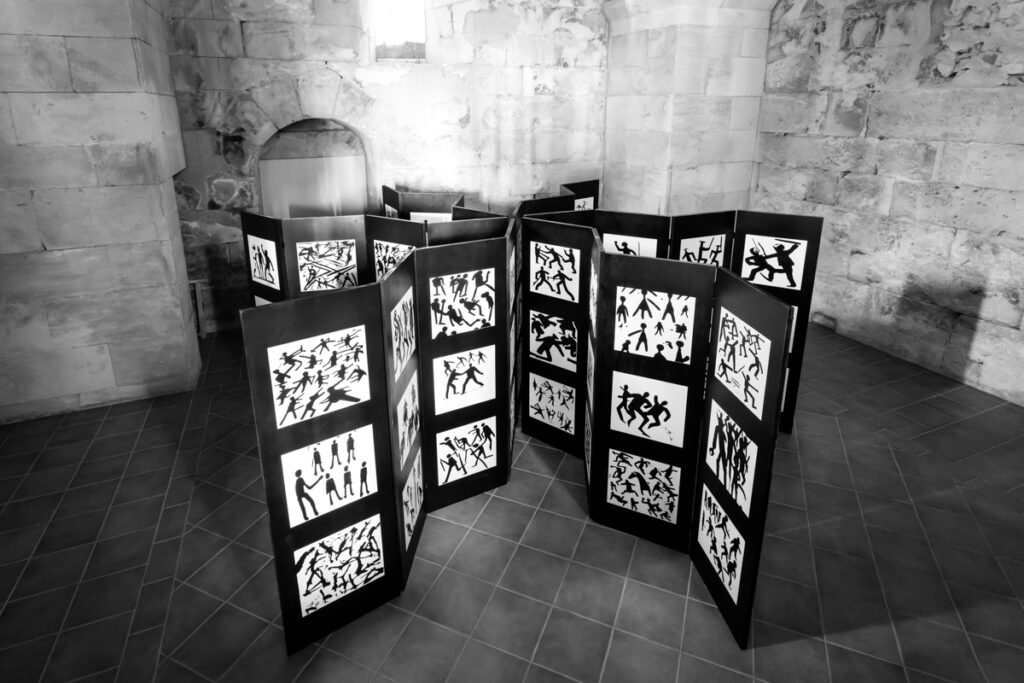
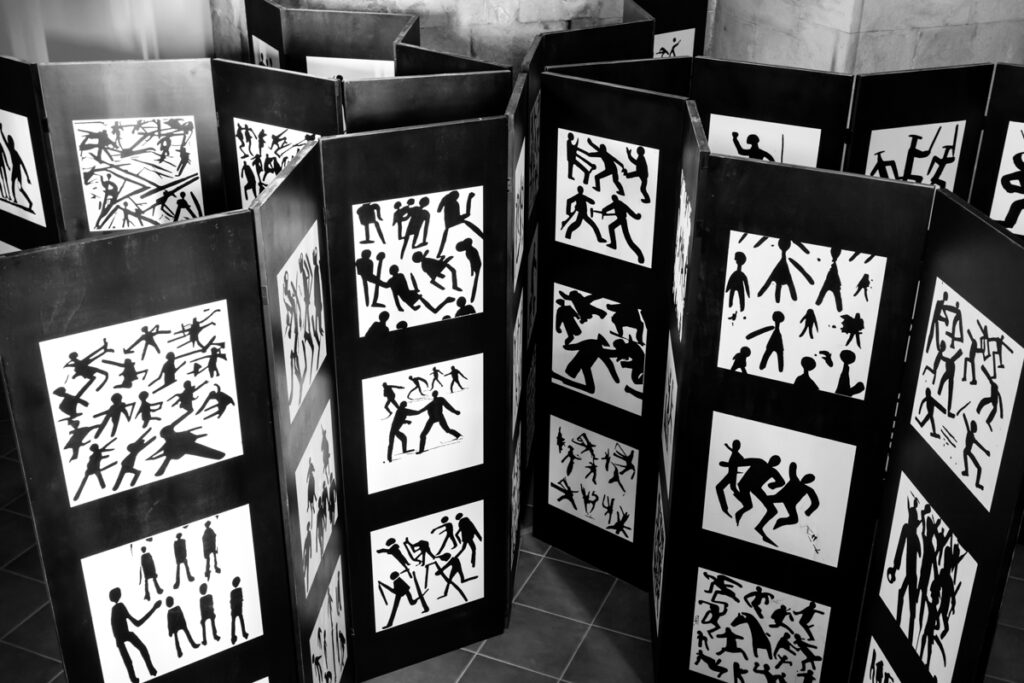
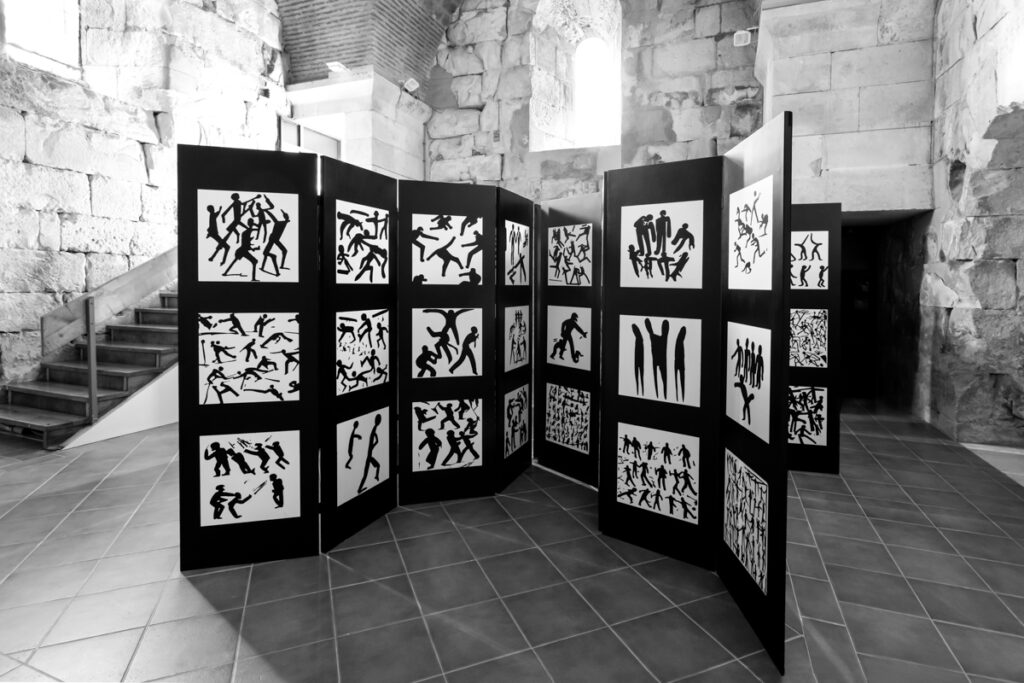
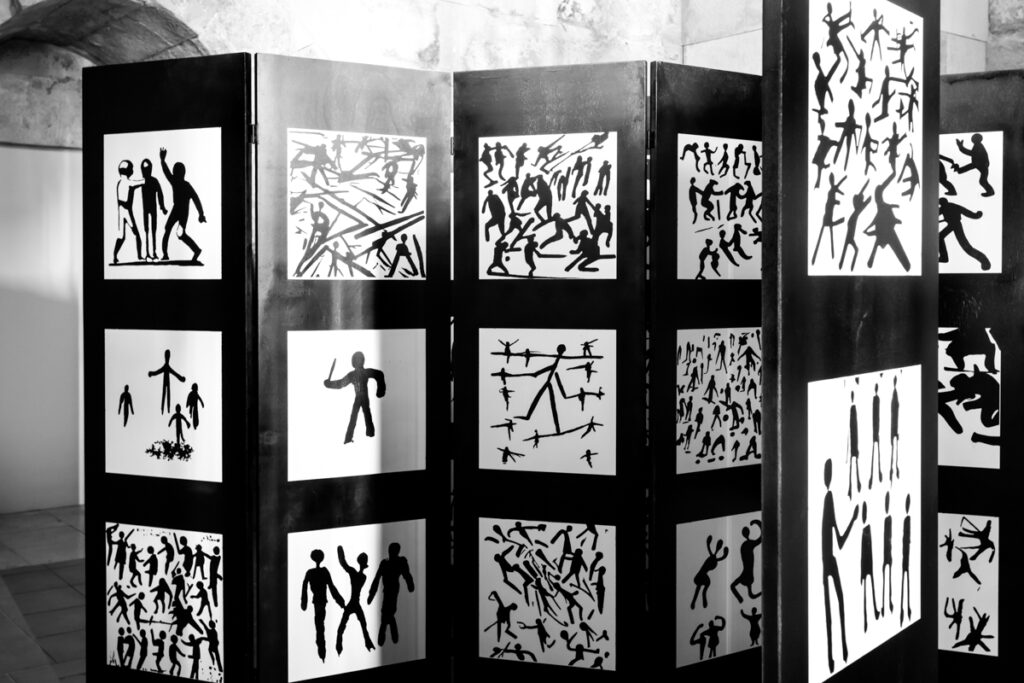
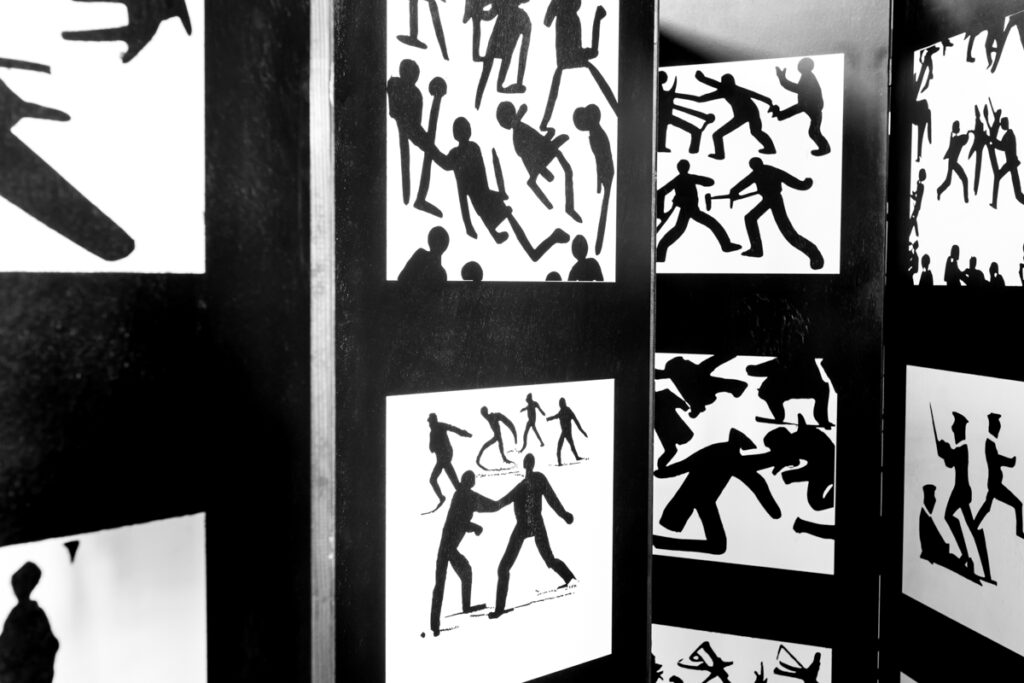
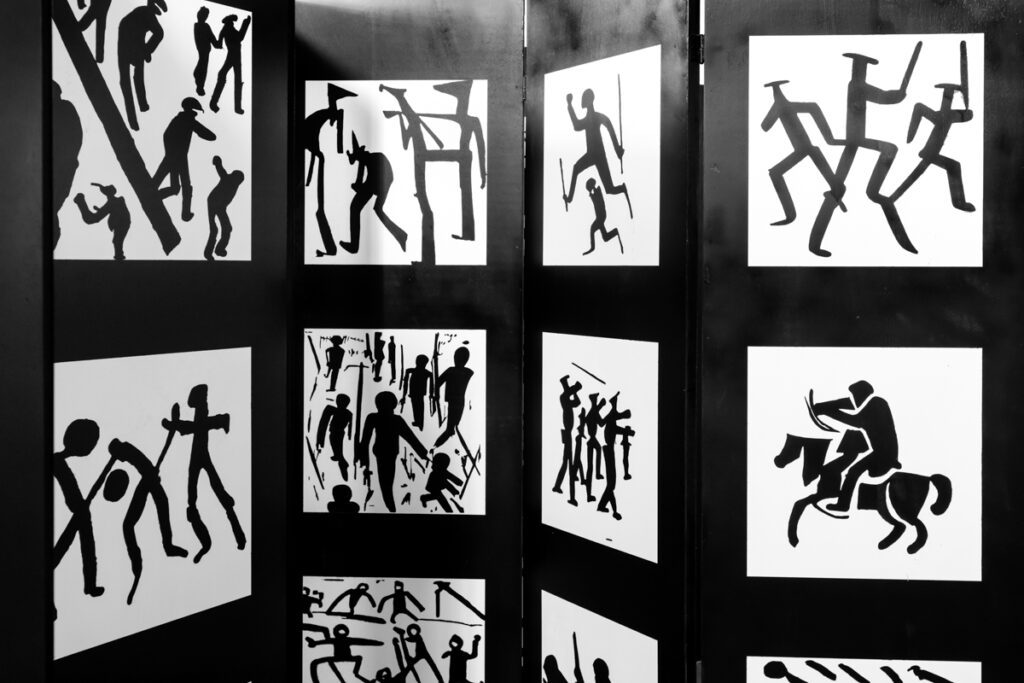
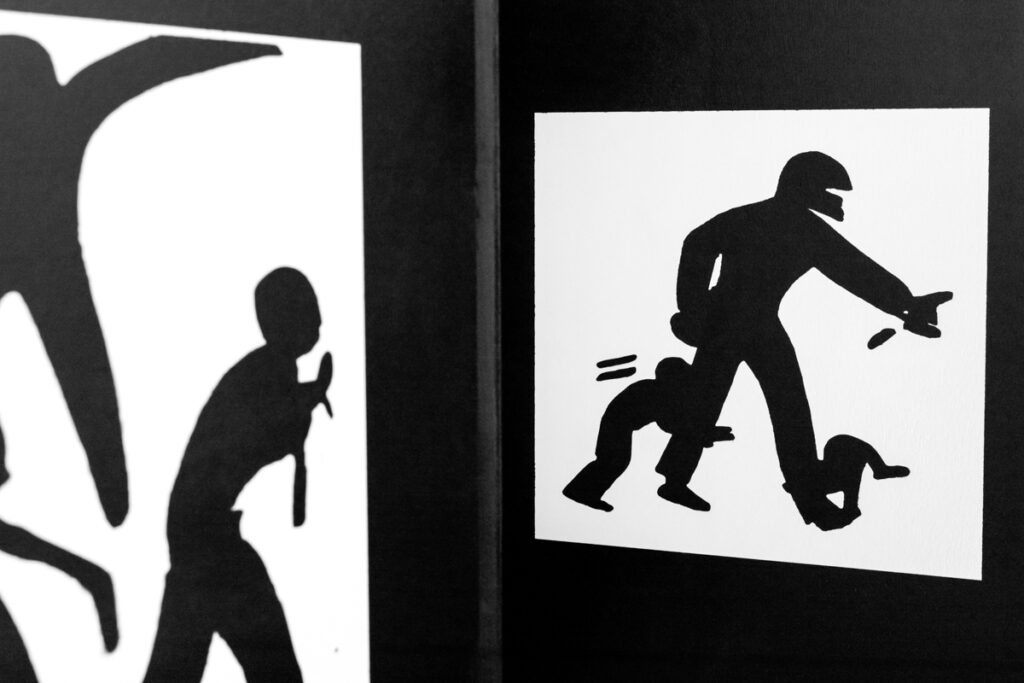
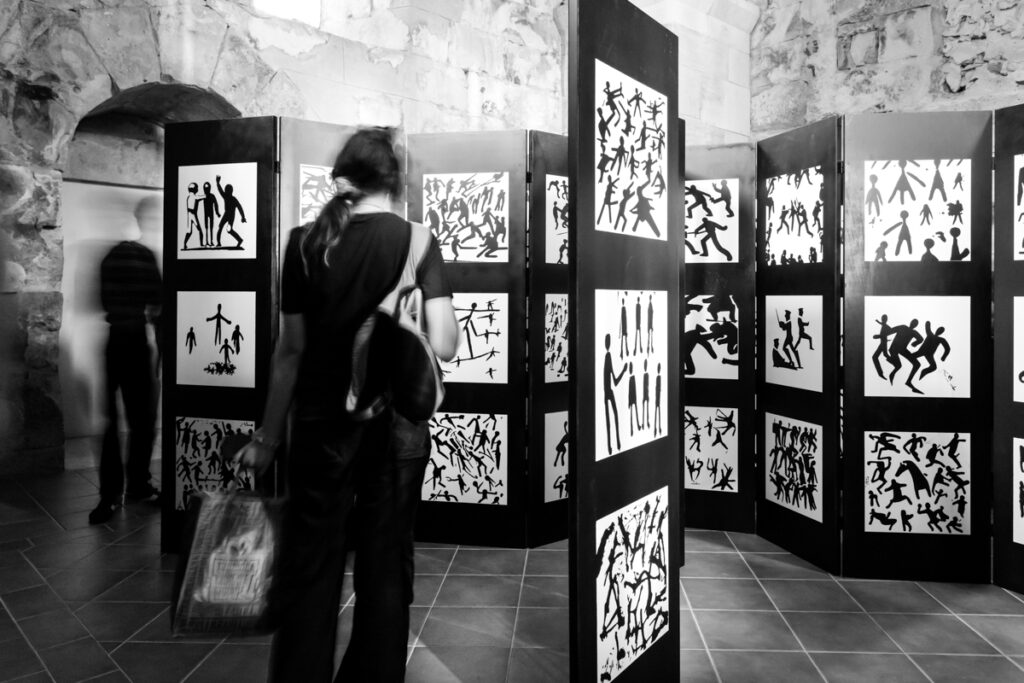
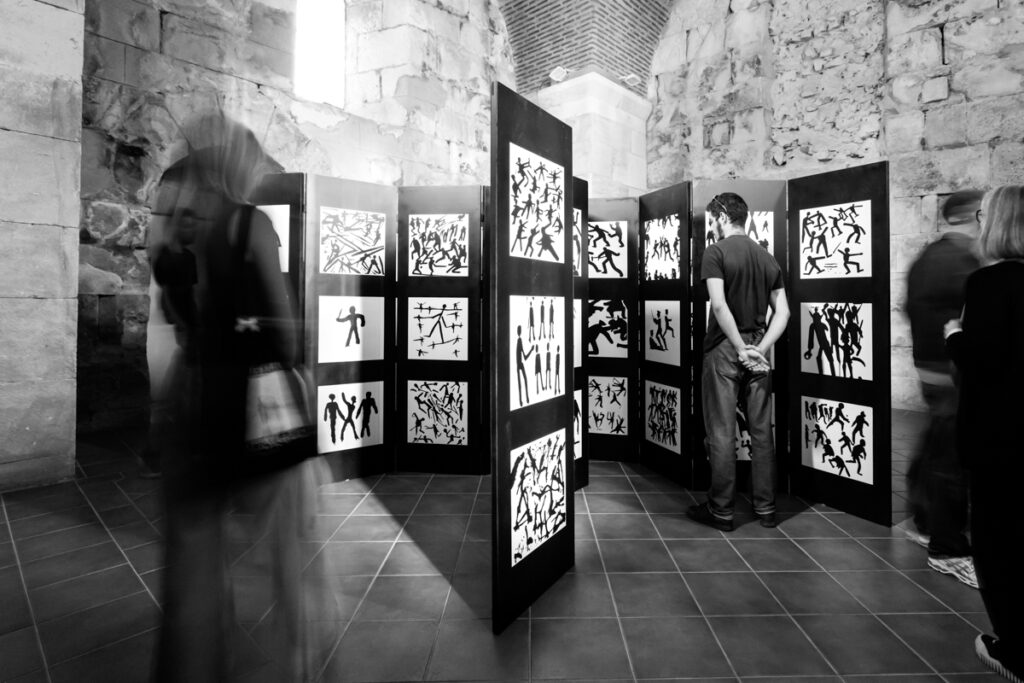
“Battle,” the piece that Mexican artist Carlos Amorales (1970) will be presenting at Kula Gallery in Split, Croatia, is a foldable pinacothèque (subdivided into six screens) in which a battle between rioters and policemen is represented with black-and-white paintings that, at first sight, look primitive but were actually generated with an Artificial Intelligence imaging program, then displayed in the exhibition space as a revolving fighting machine. The paintings depict the fictiuos battle that sparks after the super-rich have left for outer space: the moment when the poor realize they have been abandoned on a burning planet, while the police forces that protect the elite remain oblivious to their masters’ betrayal and continue to repress the protests. We see masses of people confronting riot police shields and batons. We see arms, legs and heads agaians each other. Policemen charge on foot or mounted on horses. But policemen are proletarians too… Everyone, who is not an oligarch or part of their entourage, has been left behind to die.
In visual terms, “Battle” follows up on the exhibition Riots on the Moon, presented at the end of 2023 in Madrid at Albarrán Bourdais gallery, and the publication of the artist’s book of the same title, launched earlier this year during Mexico City’s art week. Likewise, the work is thematically connected to the video The Rhetoric of the Mask, produced during the pandemic years, which serves as a visual essay about how real and metaphorical masks are used in today’s society.
In his artistic research, Carlos Amorales is interested mainly in language and the impossibility/possibility of communicating through means that are unrecognizable or not codified: sounds, gestures, and symbols. Amorales experiments at the limits between image and sign with an array of platforms: animation, video, film, drawing, installation, performance, and sound. His practice is based on different forms of translation: instruments that become characters in his films, letters that become shapes, and narratives unfold as non-verbal actions. As the basis for many of his explorations, Amorales has used Liquid Archive: a project composed of shapes, lines and nodes instead of words that he started in 1998 and continued to nourish for over ten years. In addition to Liquid Archive, he has developed other alphabets and systems that he uses to translate texts that range from museum labels to short stories. The works of Amorales exist in an alternate world of their own making, parallel to ours; constantly evolving at the same rhythm that they are produced.
Carlos Amorales lives and works in Mexico City. He studied in Amsterdam at the Gerrit Rietveld Academie (1996–97) and Rijksakademie van beeldende kunsten (1992–95). He has participated in artistic residencies at the Atelier Calder in Saché (2012) and MAC/VAL, Vitry-sur-Seine in France (2011), and as part of the Smithsonian Artist Research Fellowship program in Washington, D.C. (2010).
Among its most important exhibitions are: Black Cloud, Phoenix Art Museum, Phoenix, FL, US (2025); Black Cloud. Kunst Museum Brandts, Odense, Denmark(2023); Words of Mouth and Hands. Kurimanzutto. New York, United States (2023); Black Cloud. National Museum of Contemporary Art. Bucharest, Rumania (2023).The Snake of the Days. Museo Kaluz, Mexico City, Mexico (2022); The Factory. Stedelijk Museum. Amsterdam, Netherlands (2019); Ghost Demonstration. BAMPFA. Art Wall Project, Berkeley, United States(2019); Axioms for Action, MUAC – Museo Universitario de Arte Contemporáneo, Ciudad de México, México. (2018) (2019); Herramientas de trabajo, MAMM- Museo de Arte Moderno de Medellín, Colombia (2017); Working Class Today… Mañana Nuevos Ricos!, Fridericianum, Kassel, Alemania (2009); Carlos Amorales, Museo de Arte Latinoamericano de Buenos Aires, Argentina (2006); ¿Por qué temer al futuro?, Casa de América, Madrid and Artium, Vitoria, España (2005).
In addition to representing Mexico at the 57th Venice Biennale with the project Life in the Folds (2017), His work has been included in other biennials such as the 10th Shanghai Biennale, China (2013); 2nd and 8th Berlin Biennale (2001 and 2014); Sharjah Biennial 11, United Arab Emirates (2013); 10th and 12th Havana Biennial, Cuba (2009 and 2015); the 5th SeMA Biennale Mediacity Seoul in Seoul, Korea (2008); and he represented The Netherlands at the 50th Venice Biennale participating in the exhibition “We Are The World”.