

Žarko Paić
Transmutations of an Artistic Event Titled
“The Brilliant Self-Portrait of DM”
Within the contemporary ontology of the technosphere that I have developed through my philosophical research, the question of so-called human identity arises not from the autonomous logic of the so-called man and his phantasmatic world of dominion over other creatures in the form of an absolute subject, but rather from the heteronomy of what precedes him and what transcends him – the animal and the machine. In Dalibor Martinis’s work, all of this has already become part of the archive of “his” museum of contemporary art as a question of the end and the metamorphoses of identity, through the projects: 1) I Am Addressing You Man to Man; 2) I Am Addressing You Monkey to Monkey; 3) Request_reply.DM/2077. So-called identity is, therefore, not the eternally self-same, not something metaphysically constant, immutable, permanent, irreducible and indestructible.
Rather, every identity, like a windowless monad, is a perpetual process of change and transformation, resisting reduction to any shared denominator of the human-all-too-human, for it inhabits at once a pre-reflective and posthuman condition, the primordially animal and the superhuman together, in the form of “spiritual machines” that generate new worlds.
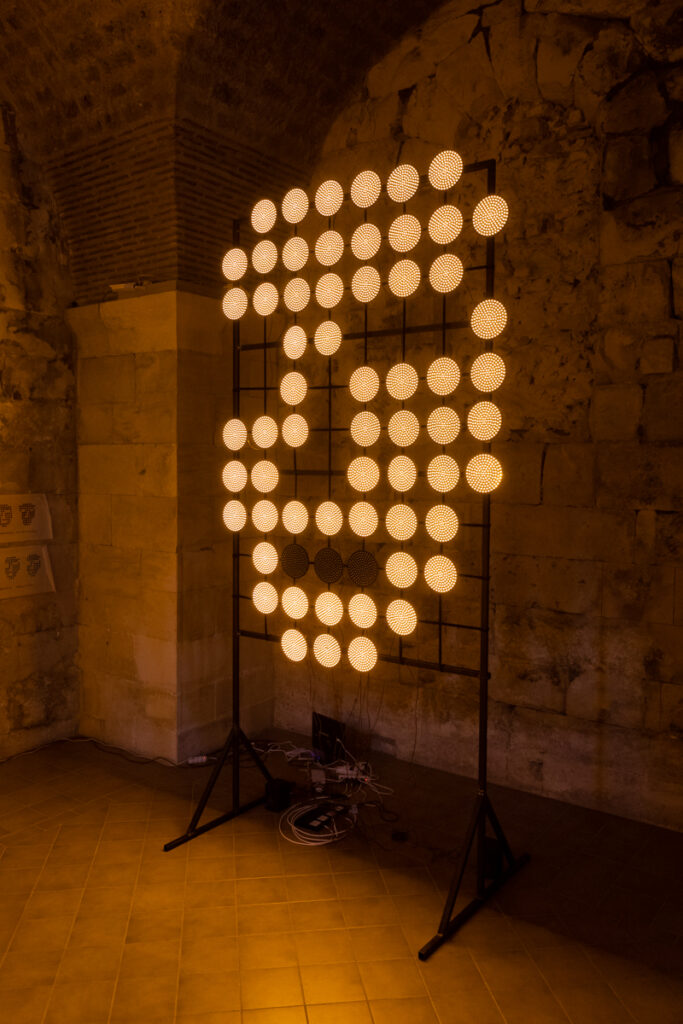
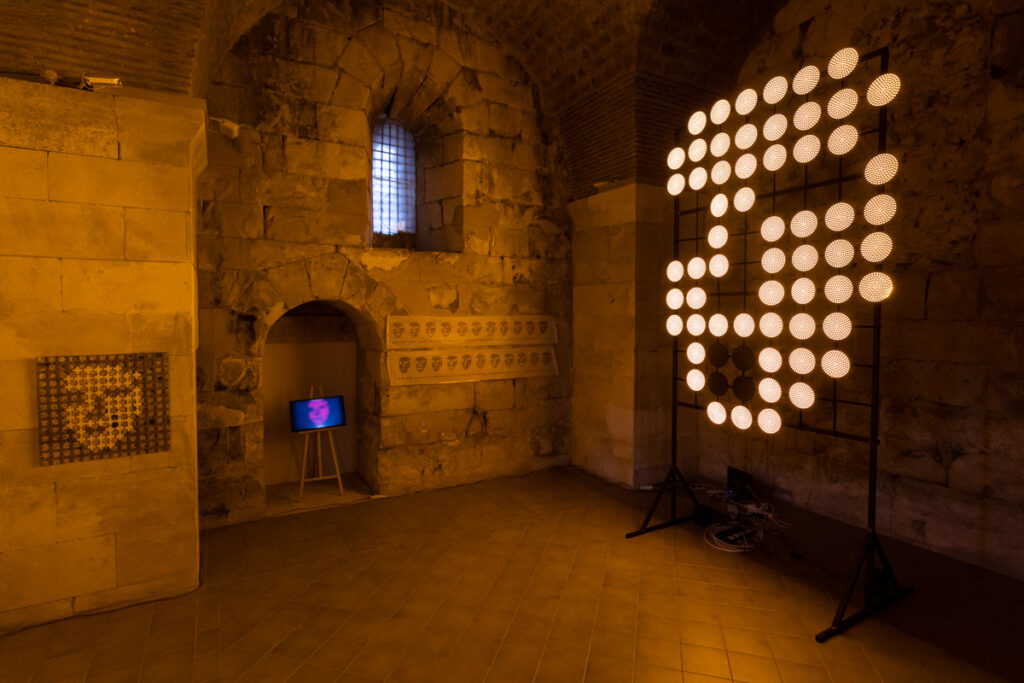
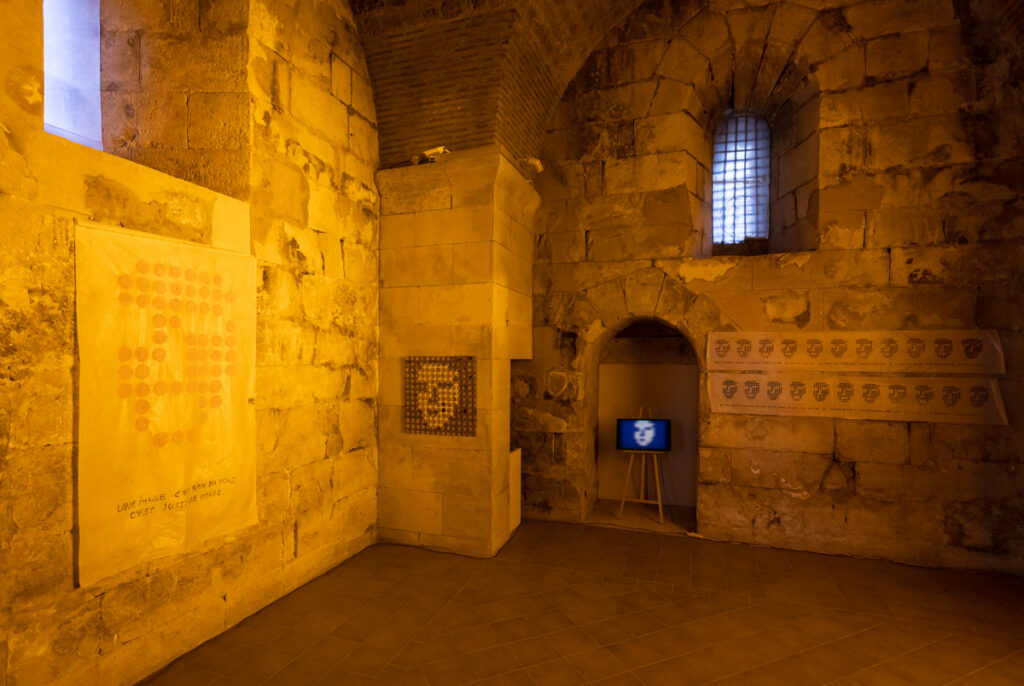
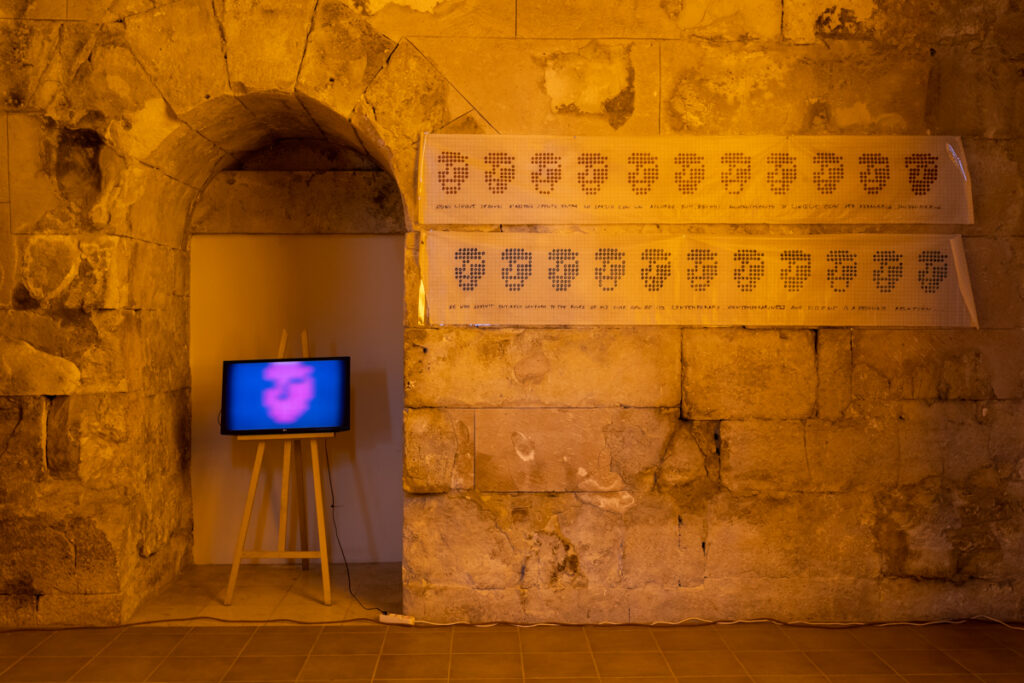
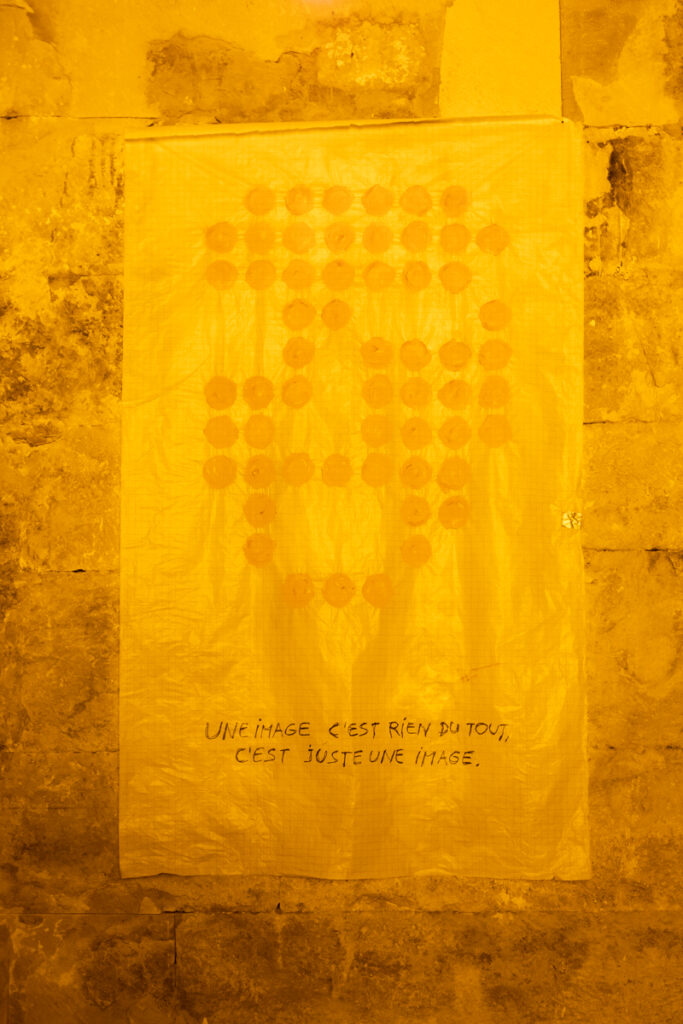
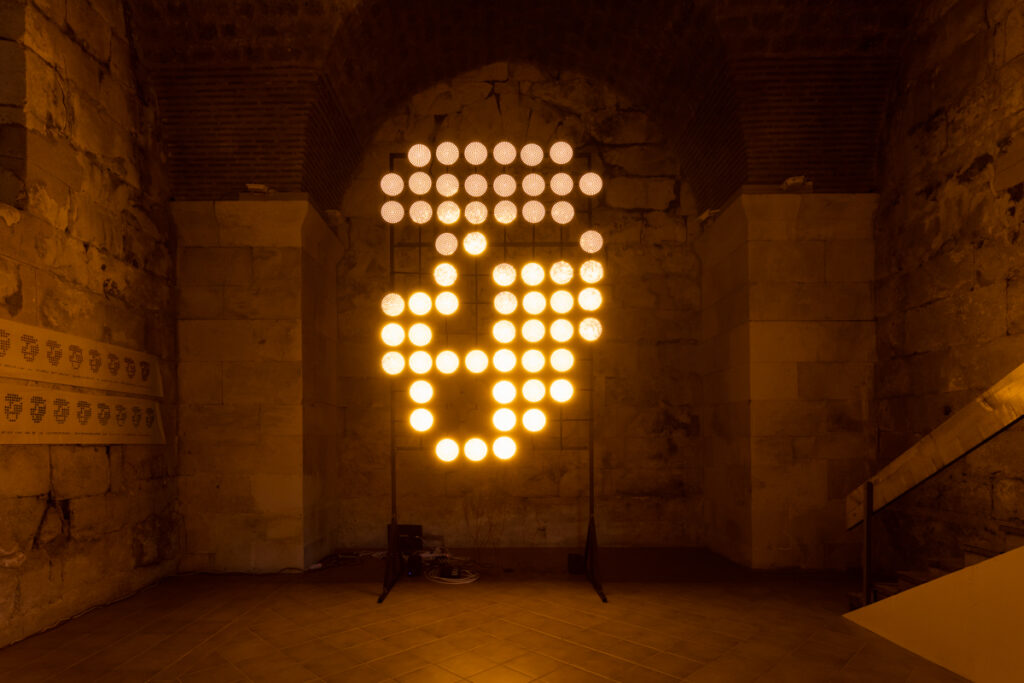
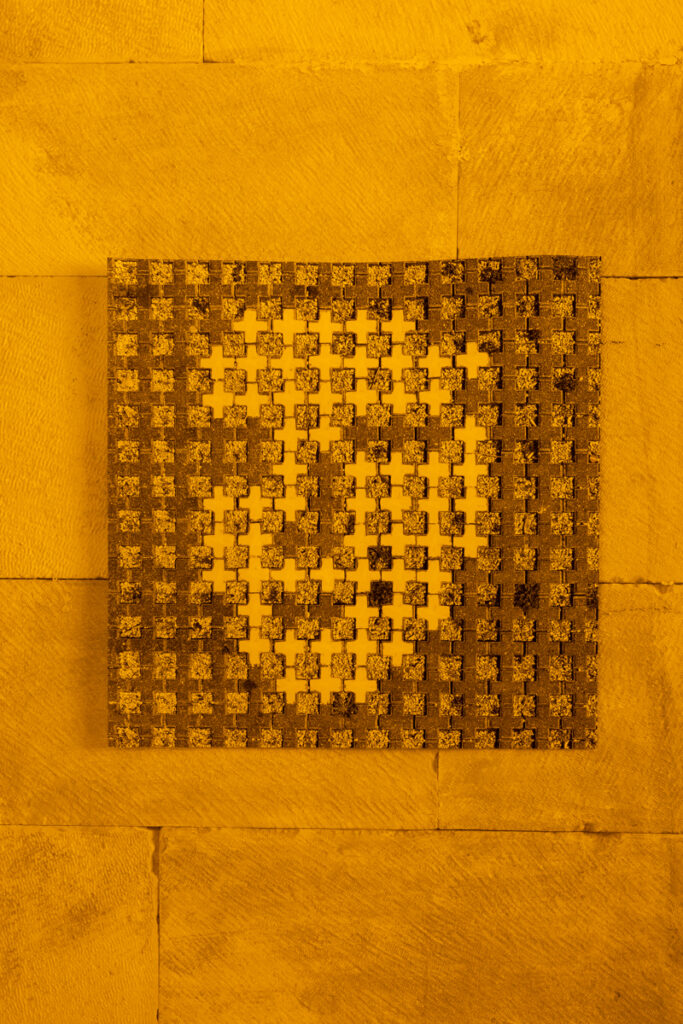
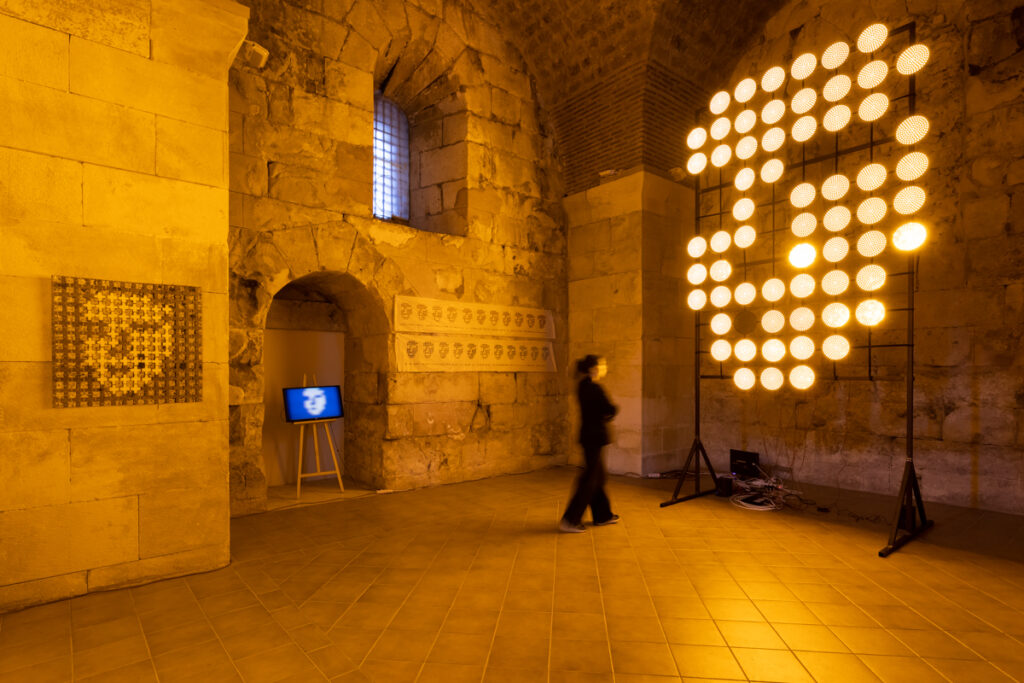
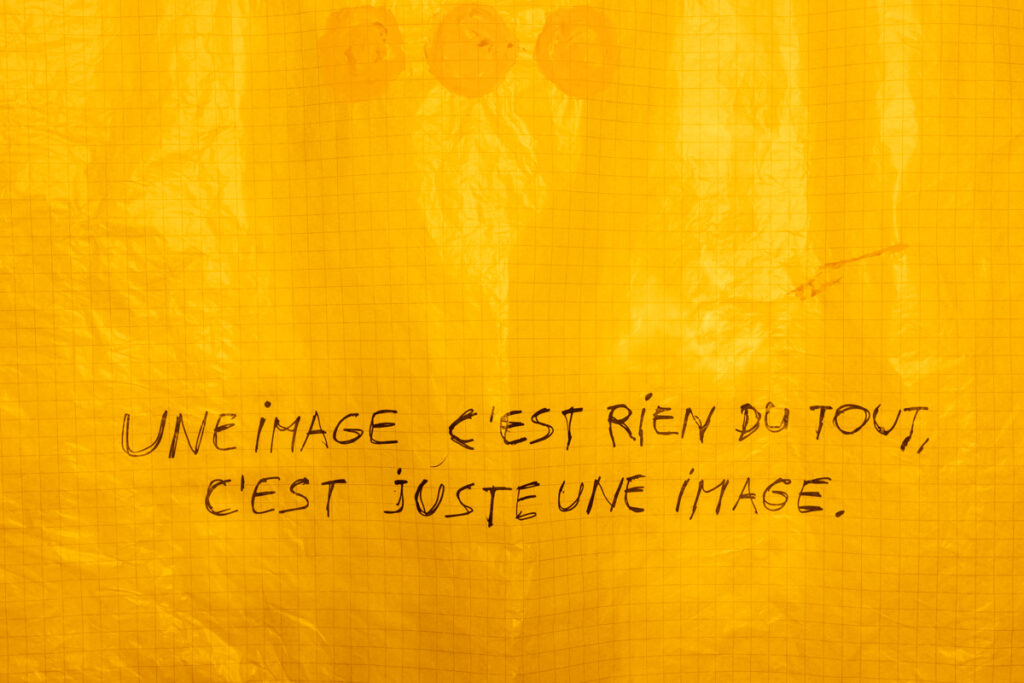
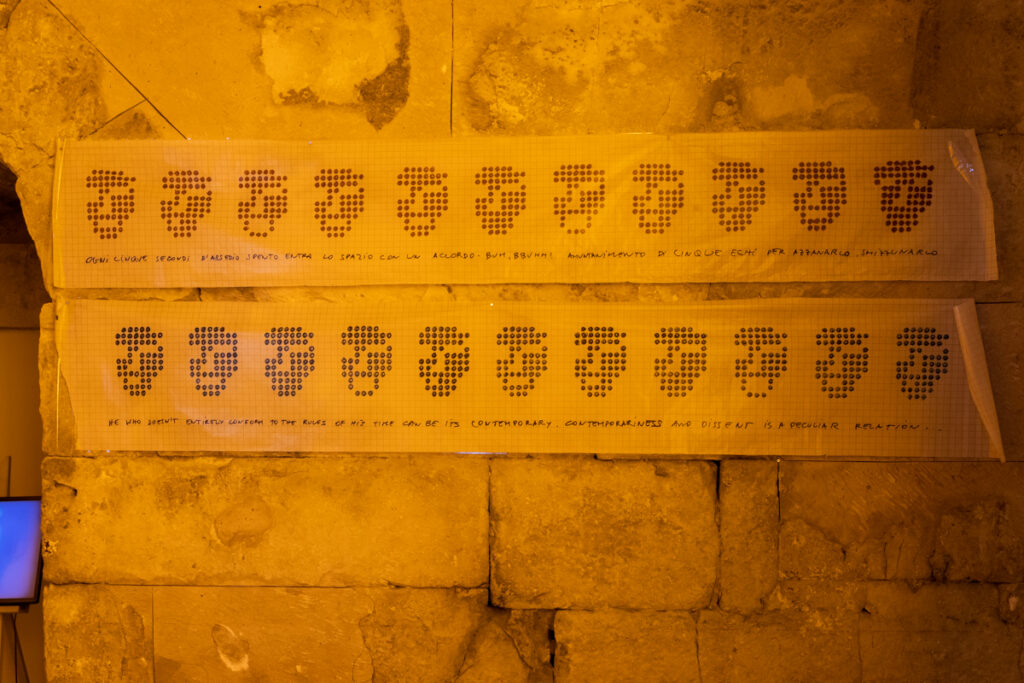
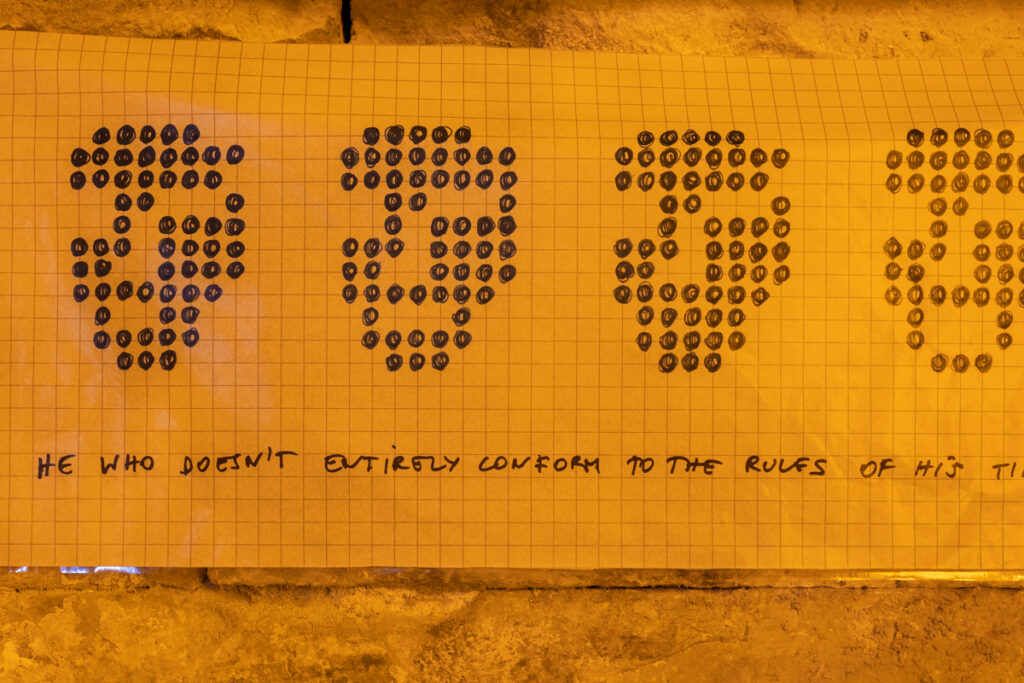
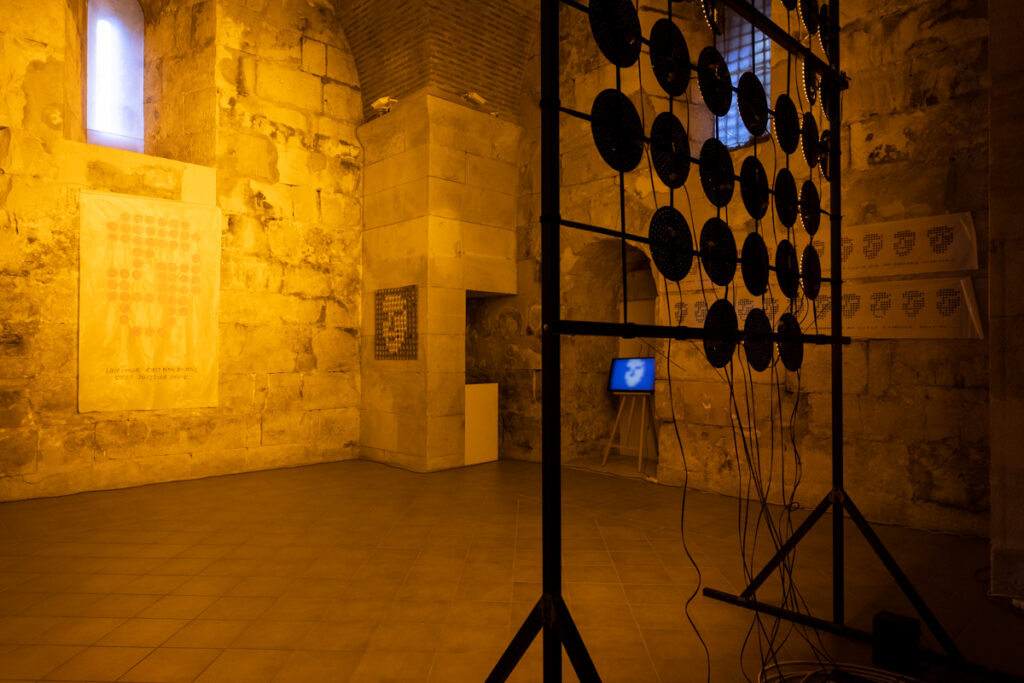
In his latest work, “The Brilliant Self-Portrait of DM,” a light-and-sound installation that challenges the very notion of video installation, the artist appears in low resolution, his face elevated high within the space and inevitably enlarged. As the artist himself explains, the pixels composing his face are actually yellow traffic lights. But the work grows more challenging still: his mouth gives voice to the thoughts of preeminent figures in contemporary art and philosophy, such as Nam June Paik, F.T. Marinetti, Tristan Tzara, Marcel Duchamp, Jean-Luc Godard, Andy Warhol, John Cage, Giorgio Agamben…
Much like history, these thoughts have become “embodied” as post-memory of something that functions simultaneously as an archive of sorts, and dispositif of contemporary art, and they are not the property of the “subjects” who articulate them, in any sense of solipsistically appropriated ownership by the “authors” in question, towards whom the so-called cultural public tends to maintain a certain reverence and deference, even when it finds itself at odds with their views. DM is therefore no longer the one who persistently and perpetually “is” as the artist Dalibor Martinis, nor is he his double nor alter ego, nor yet the acronym of some heteronym along the lines of what the Portuguese poet Fernando Pessoa did when he multiplied himself into the Other.
What does this new light-and-sound installation project in the form of the “brilliant self-portrait of DM” “depict” and “represent” within the broader context of his previous works, in which he has continually questioned this most fundamental problem of contemporaneity? If the “man” is already, in his essential possibilities, an obsolete creature of a biologically exhausted history that culminated in the age of the Anthropocene, then his reduction to the logic of the technosphere constitutes a passage into the form of homo cyberneticus, a being that thinks differently by calculating, planning and constructing his own “I” as a fractal transversality that can never be comprehended through the language of metaphysics and its myth of the eternal persistence of the self-same.
This transition takes place through the “voices” of Others and through the constitution of the “Great Third” as a “spiritual machine”, one in which the very idea of contemporary art, in its triad of installation, performance and conceptuality, becomes oriented towards the approaching future of the transmutation of the event of life itself as realised art beyond the boundaries of the animal, the human and the technological.
The individual is always incomplete and (whatever he may be) always finds himself drawn into new processes of individuation until his death/obsolescence. The French philosopher of cybernetics Gilbert Simondon does not, however, stop at this concept of individuation, but instead develops the concept of the transindividual in his book L’individuation psychique et collective (Psychic and Collective Individuation, Aubier, Paris, 1989). Transindividuation denotes the operation by which a number of individuals (born out of successive operations of this process of individuation) construct a relationship amongst themselves that ultimately forms a consistent aggregate which Simondon calls transindividuality.
All of this is connected to what belongs to the age of the dominion of the technosphere, understood not merely as an assemblage of machines serving the human being as its “extensions,” as the primitive “humanists” of every persuasion in philosophy and art still maintain, but as autonomous systems of action that lie beyond all boundaries of human subjectivity, with its relics of “pride and honour,” “vanity and frivolity,” “anger and fury.” To be-beyond and to cross the boundaries of individuality means to be perpetually in a state of becoming-Other within that which is, in its essential reaches, determined by the “Great Third,” no longer as God, substance, or cosmogenesis.
Everything is now finally realised in the very essence of artificial life (A-life) as an event that does not create a work of art. Instead, creation itself passes through the speech and thoughts of Others as the transmuted language of the brilliant visualisation of the “face” of the Artist known as DM, in the form of his self-portrait that no longer bears any strict characteristics of the “appropriation” of one’s own selfhood as absolute control over the world of appearances of an obsolete individuation and its “empire of originality.” Incidentally, the term transmutation simply denotes an alteration, a change, a conversion of one element into another.
The question is no longer even “what” the Artist DM desires and intends with this project of transindividuation of his own otherness of Others, and still less “who” actually shines like a yellow traffic light behind his brilliant self-portrait. No, the only question is “how” that which is no longer anything determinate comes into being, that dark object of transindividuation that crosses all boundaries of “my” language and “your” image without a world. For, as far back as 1990, in the video installation Supper at Last (1990–1992), Dalibor Martinis opened up the problem of “one’s own” transformation into the simulacrum of a work of art without the “signature” of one’s own hand and without the apology of “subjectivity.”
In that work, each chair within the setting of the “Last Supper” was fitted with headphones through which visitors could listen to recorded voices of renowned figures of the 20th century, including Marcel Duchamp, Sigmund Freud, Frida Kahlo, Elvis Presley, Bertolt Brecht, Marilyn Monroe, Donald Duck and others.
All of DM’s “works” refer to his own and certain other works and, through the transmediality of their own staging, ultimately lead spectators to the point where there is neither beginning nor end, for everything is simply a “brilliant transmutation” of the artistic event through which DM projects even “himself” as a spectator in a cinema amongst other spectators, watching that which is no longer either the subject of an image or the object of one’s own apprehension.
What renders possible the great festivity of the gaze into the light of the image is nothing but the event of life’s own transmutation, that which moves through time by traversing space from its inception to its dissolution.
To witness what takes place at the very heart of change means to belong to a community of thought and participation through which contemporary art transcends its own boundaries of space-time, proliferating into an endless multitude of other voices with which everything becomes what it no longer is and what it is yet to become in the oncoming projection of a different world.
Dalibor Martinis is a leading Croatian transmedial and video artist, internationally recognized for his work with video, performance, and time‑based media. Emerging in the 1970s, he became associated with experimental and conceptual art practices in former Yugoslavia. His projects often explore themes of time, identity, and the relationship between media and society
Born in Zagreb in 1947. Graduated from the Academy of Fine Arts in Zagreb. He has been exhibiting since 1969, since 1973 he has been working as a video author. He held numerous independent exhibitions, performances and screenings and participated in numerous international exhibitions (Biennales in Venice, Sao Paulo, Kwangju, Thessaloniki, Cetinje, Cairo and Ljubljana; Dokumenta Kassel, Triennale Riga, etc.). His video works and films have been shown at video festivals in Berlin, Tokyo, Montreal, Locarno and at international film festivals in Oberhausen, Bogotá, Vienna, Taormina, Seattle, Nice, Montreal, Ljubljana and others.
He taught at the Academy of Dramatic Arts in Zagreb, at the Ontario College of Art in Toronto, and at the Academy of Applied Arts, University of Rijeka where he is a professor emeritus.
He has won several international awards (Tokyo Video Festival 1984, Locarno 1984, Alpe/Adria Film Festival Trieste 1996, Festival de Cine de Bogotá 2014, etc.). He is the recipient of the Vjesnik “Josip Račić” Award in 1995, the City of Zagreb Award in 1998., the 1st T-HT Award in 2013, the Vladimir Nazor Award in 2016, the Split Film Festival Special Award for Contribution to the Development of the Art of Moving Images in 2023, etc.
His works are in the collections of the Museum of Contemporary Art/Zagreb, The Museum of Modern Art/New York, Stedelijk Museum/Amsterdam, ZKM/Karlsruhe, New York Public Library, Kontakt/Erste Bank/Vienna, etc.
Martinis lives in Zagreb.