
Body of the Void
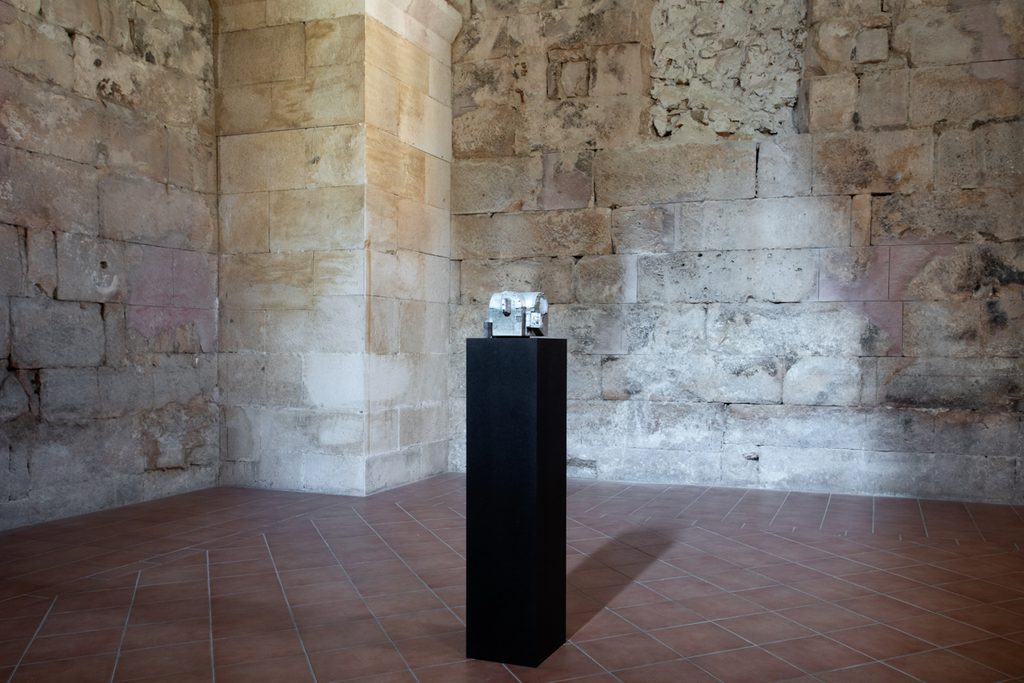
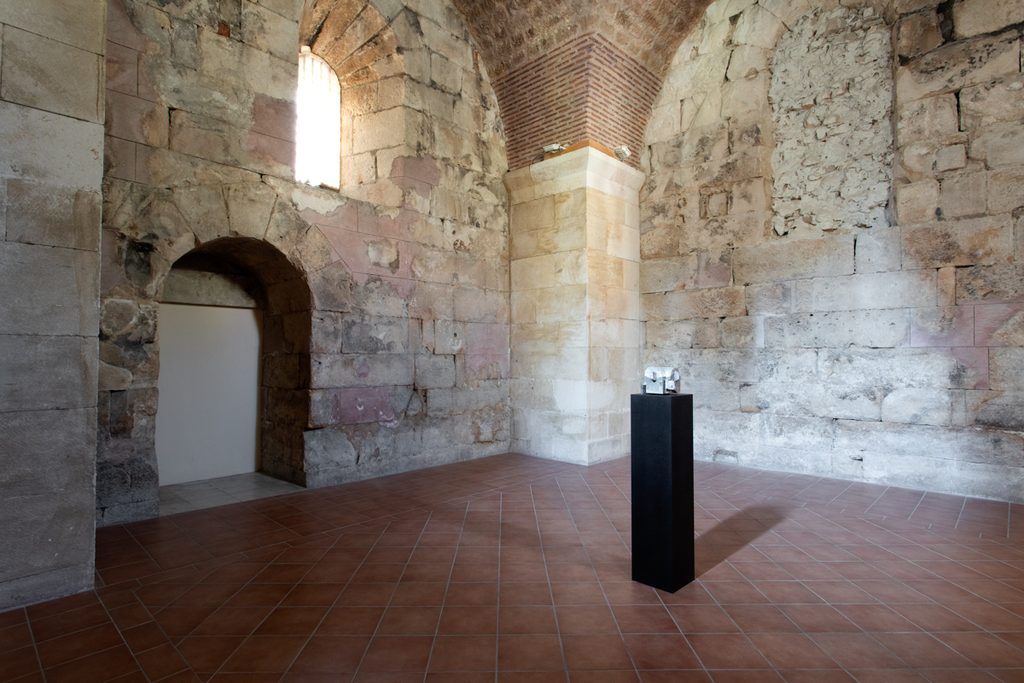
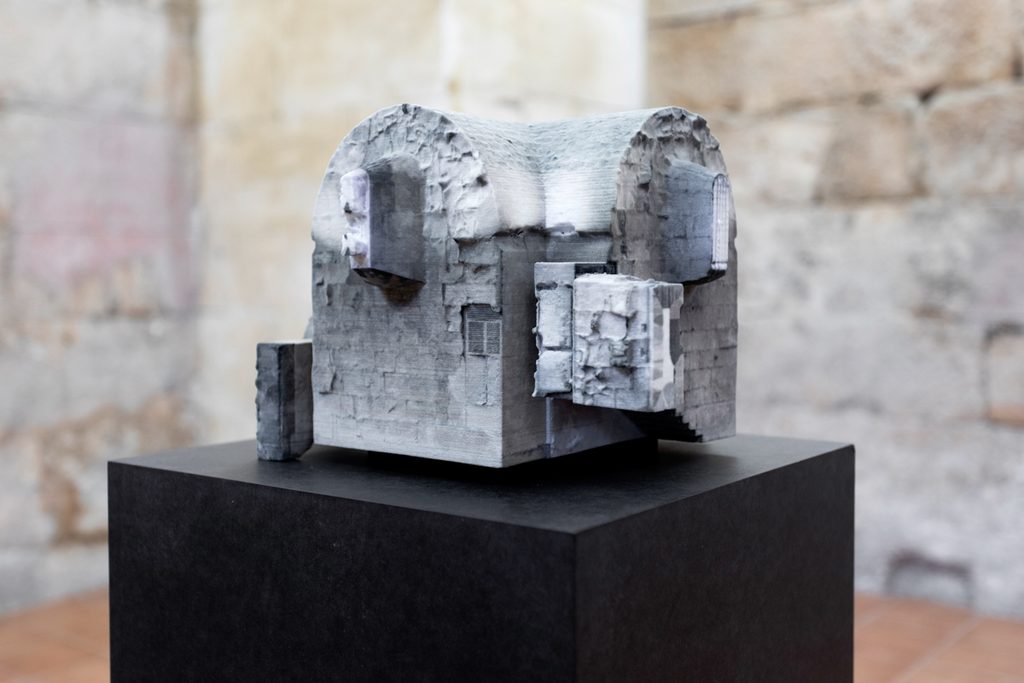
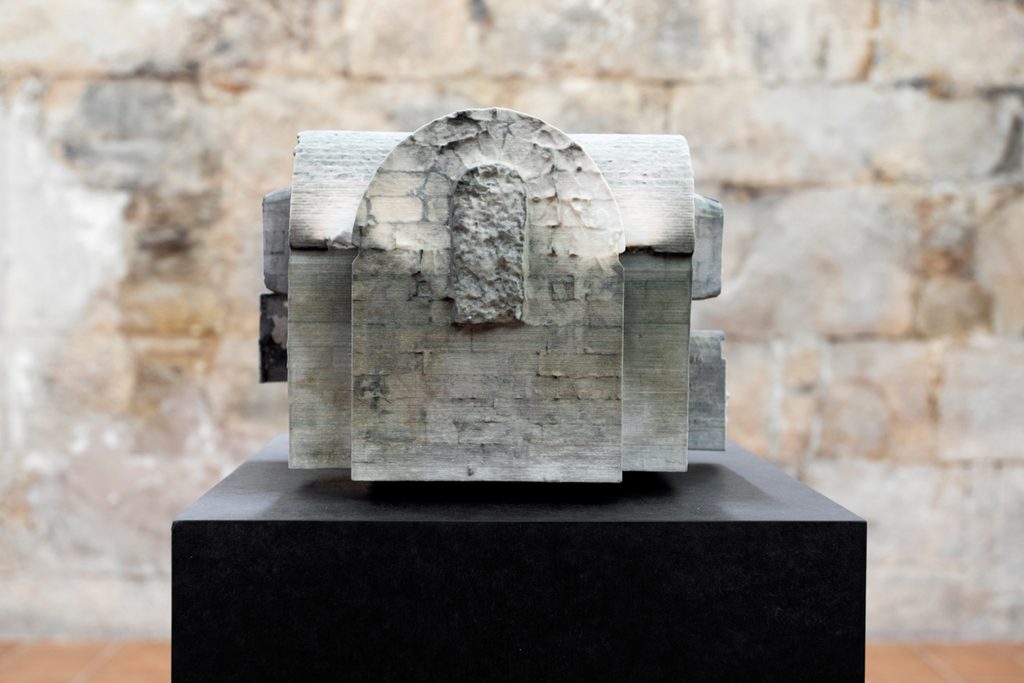
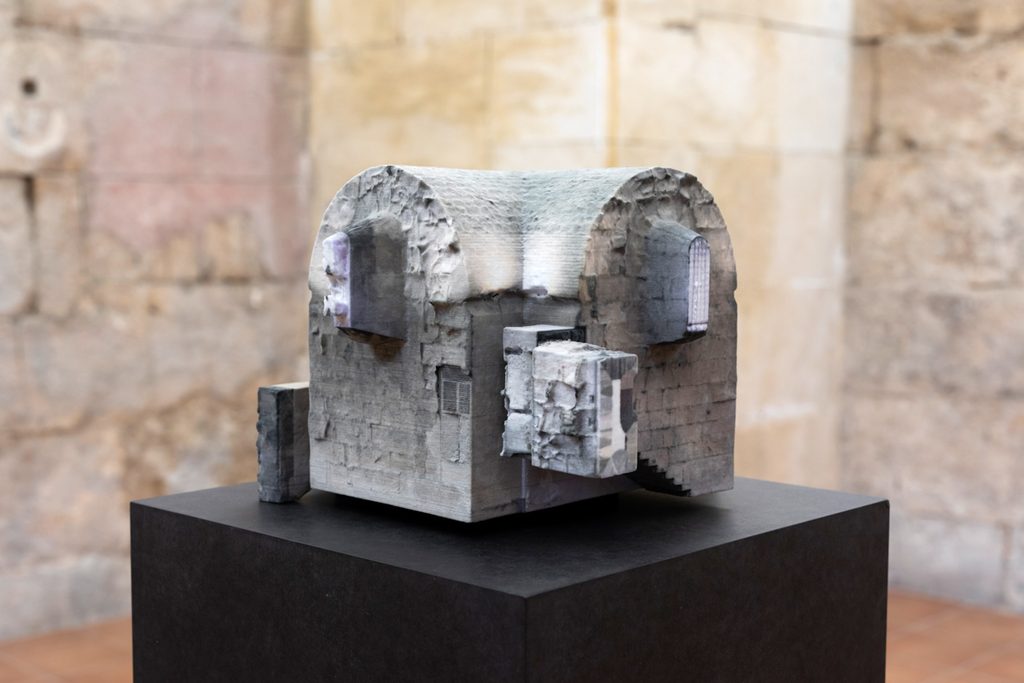
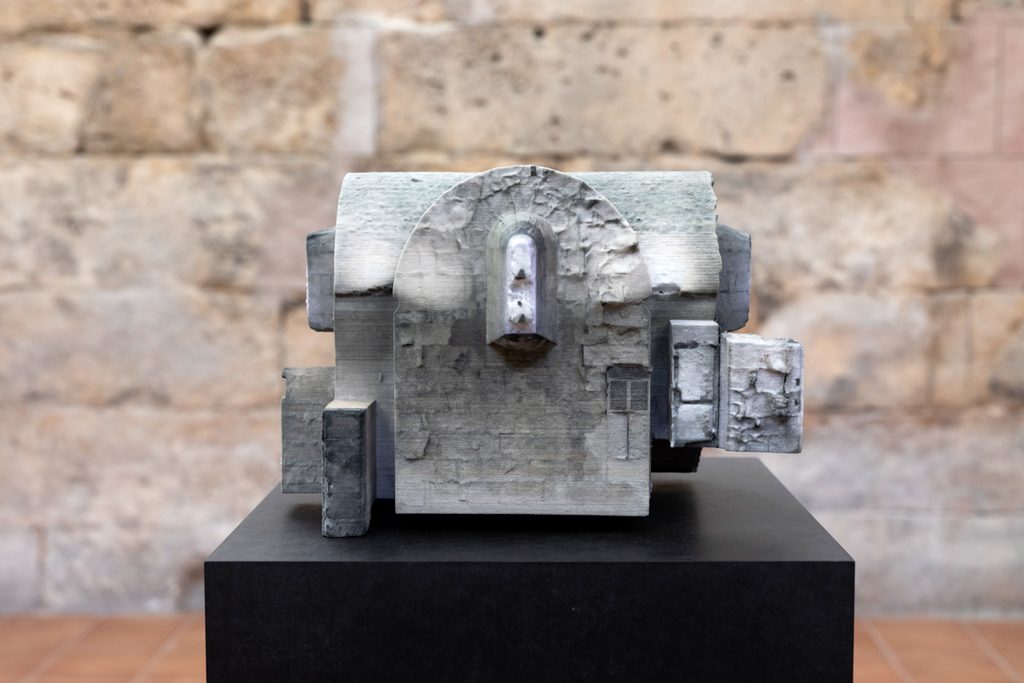
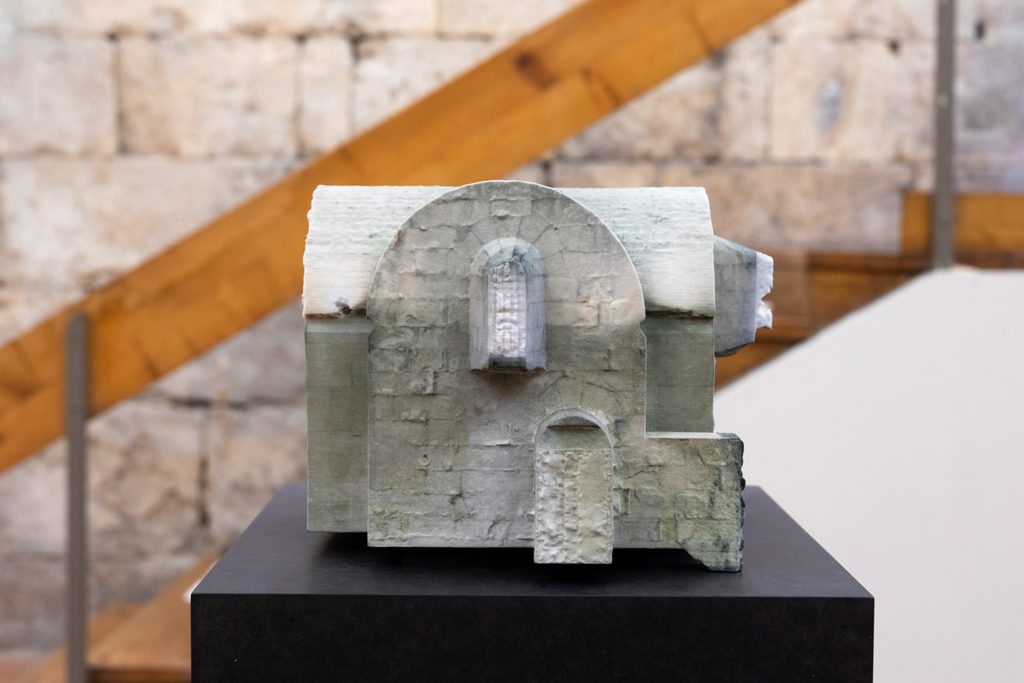
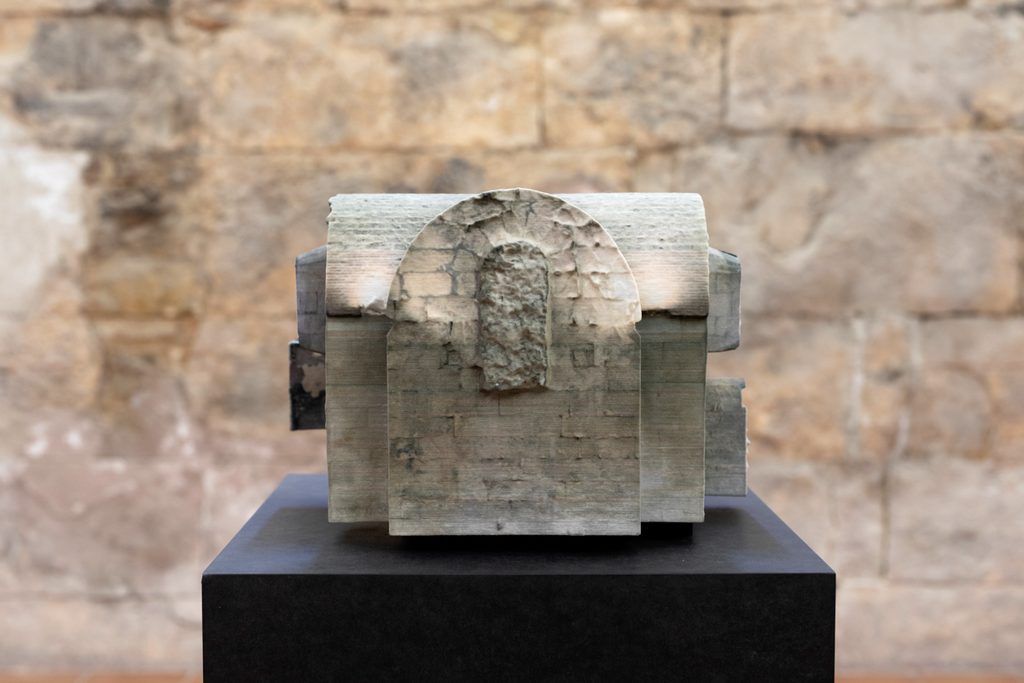
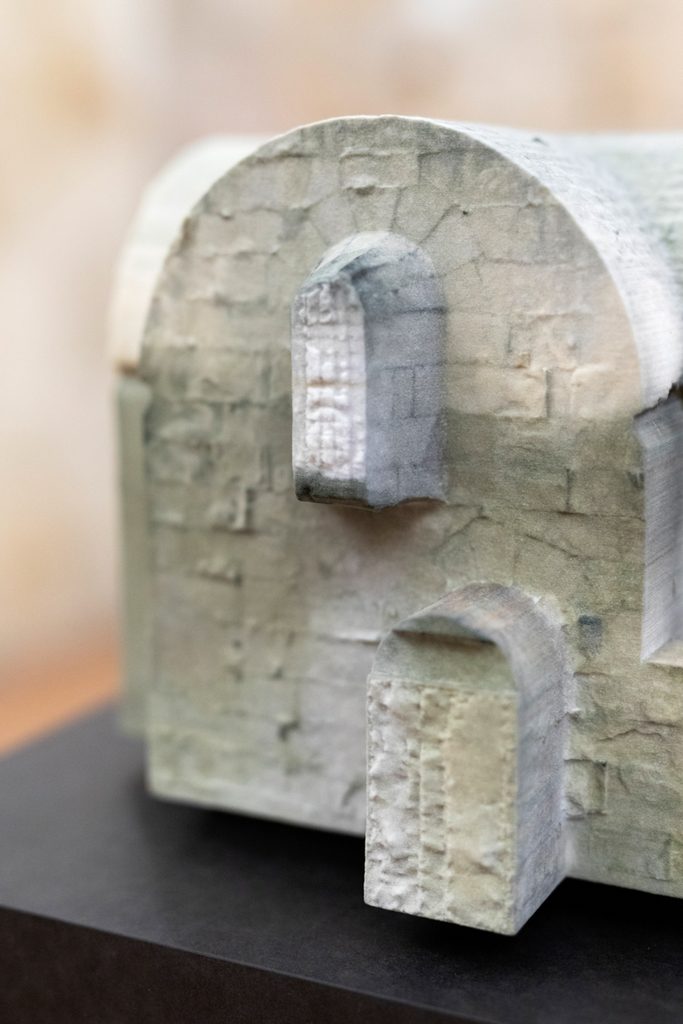
Karin Sander’s starting point at the Kula Gallery is the exhibition space itself and its architecture, which is normally experienced gradually, as the body moves, the gaze shifts and one draws closer to different parts of the space. Her process involves precise 3D scanning to capture the interior, vaults, walls, deep window niches, floor, staircase and entrance door; this data is then reduced in scale and materialised into a three-dimensional plaster print. The space, previously the surrounding environment of the observer’s body, is thereby condensed into an object positioned before him. The change of scale plays a decisive role here. Architecture, which in reality can only be experienced from the inside and in parts, is here rendered almost entirely visible at once. This reduction in scale enables a perceptual apprehension that real space itself precludes. This already points towards one of the keys to understanding the exhibition’s title – Ideospace. For space appears here both as the physical fact of architecture and as something shaped by its perception, measurement, translation and imagination. Between the actual Kula and its miniaturised double, an intermediate space is formed, in which spatial experience is converted into data, and data is, in turn, converted back into material form. This represents one of the possible interpretative directions of the work. What in reality exceeds us in scale and determines the conditions of our movement can now be perceived almost in its entirety. The altered scale temporarily reconfigures the relationship between body and architecture. The space that ordinarily envelops us becomes something we ourselves can visually possess, measure and oversee. This capacity for apprehension is, however, only apparent, since the wholeness achieved through miniaturisation simultaneously signals a withdrawal from direct spatial experience. The gaze passes over the volume, lingers on recesses and protrusions, and traces the surface’s breaks and transitions. In doing so, it approaches the condition of touch. Visual experience thereby acquires a haptic quality, as though the object might be gauged by hand, cupped in the palms, or explored with fingertips. Miniaturisation, in this process, does not simply produce a reduced version of an existing space; rather, it transforms its sensory and cognitive status. Ideospace can thus be understood as a space that resists reduction to any one of these levels, existing simultaneously as architecture, experience, information, mental representation and object.
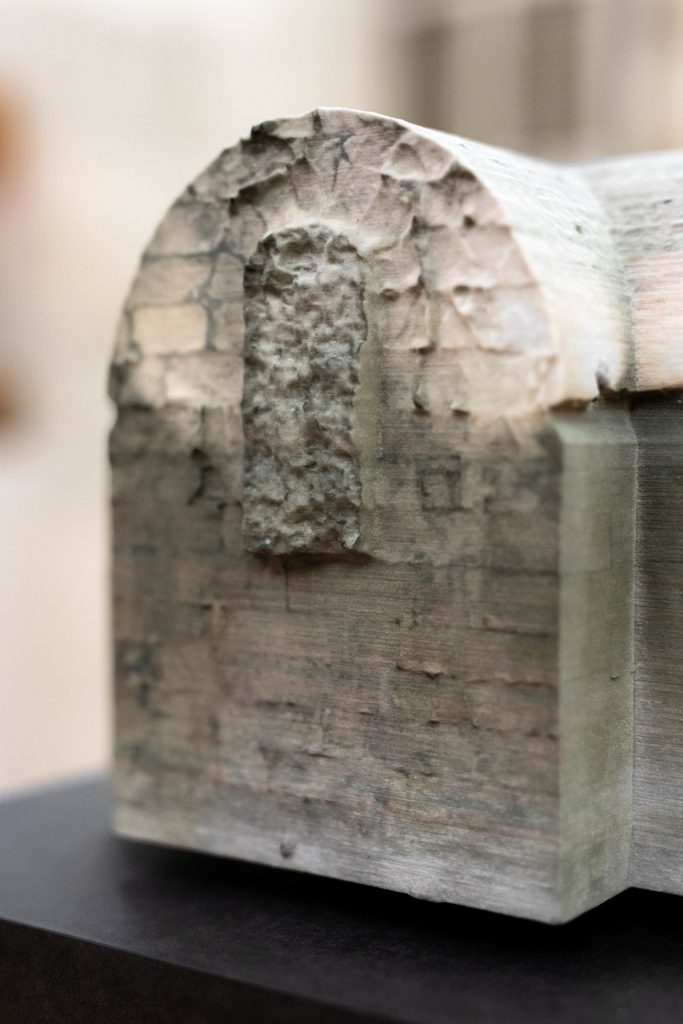
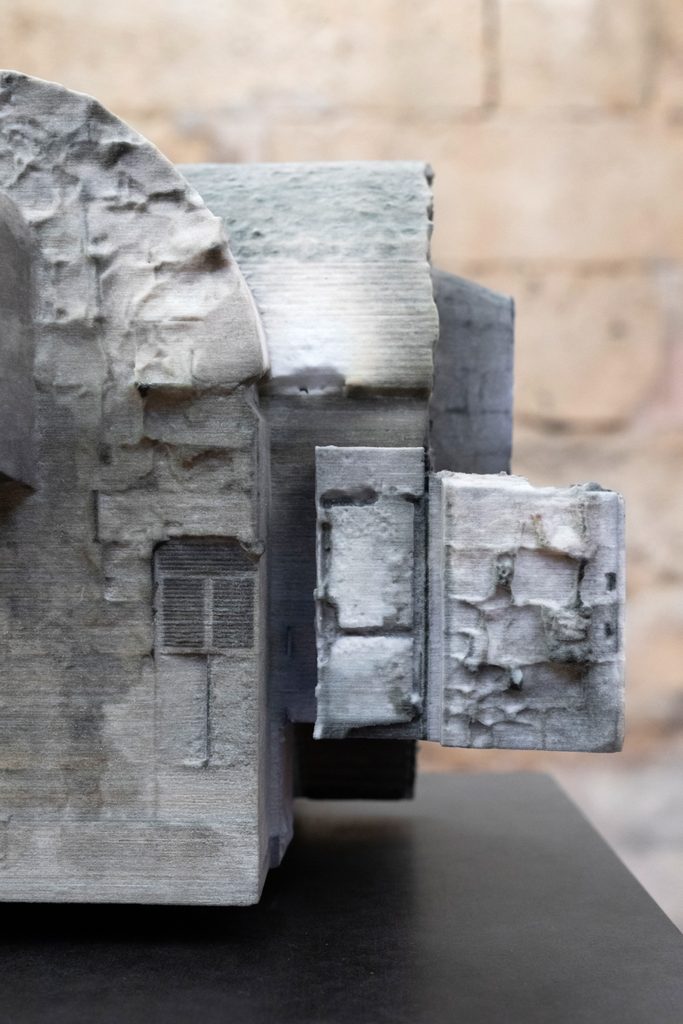
The most striking reversal occurs in the relationship between void and mass: what in architecture is experienced as interior, the free space between walls, floor and vault, here acquires volume. The void is materialised and begins to function like a body, so that interior becomes exterior, and the spatial negative assumes the properties of a positive. This gives rise to an object whose sculptural quality appears almost self-evident, notwithstanding the fact that its body was formed from what had previously been immaterial. Such an inversion may also evoke the process of casting. Just as a cast retains the trace of a body once present, so Karin Sander’s object materialises the shape of a void defined by the architectural membrane surrounding it. Here, however, the “imprint” does not belong to a single body, but instead gathers the space through which numerous bodies have passed over time. The void may therefore be understood as a repository of absent presences, although the work does not attempt to reconstruct or name them. The void itself thus proves to be less empty than it initially appears. It becomes a space of possible projections, memories and imagined presences, a form of ideospace in which the material and the mental can no longer be entirely distinguished. The plinth, furthermore, appears to direct such a reading. Raised and set apart from the immediate continuity of the architecture, the miniaturised volume assumes the status of a sculpture. The observer is able to circle it, observe it from various angles and measure it against their own body. However, the relationship of scale is here inverted. The actual Kula encompasses the observer, whereas its reduced spatial imprint becomes, in turn, the object of the observer’s grasp. In this inversion of the relationship between body and space, a distinct uncanniness arises. That which ordinarily contains us is now positioned before us, reduced to the scale of an object, while the status of the architecture simultaneously shifts. It momentarily ceases to function solely as a condition for viewing and becomes, itself, an object of the gaze. Attention is thereby directed towards that which, within an exhibition context, usually remains in the background, towards space that organises our movement, determines distances and shapes the manner in which we encounter a work of art. Sander thus appears to turn the exhibition apparatus back upon itself.
This shift can easily provoke a mild unease. The familiar space feels both recognisable and alien. Its relationships remain preserved, yet the changed scale liberates them from immediate function, drawing them closer to an abstract configuration of masses, recesses and transitions. The miniaturised Kula evokes its own architectural origin while nonetheless resisting it, eluding complete identification. Its interior thus manifests as a kind of spatial double, a condensed image of space that possesses mass. Perhaps it is precisely in this proximity without complete correspondence that the source of a certain unease produced by the object is to be found. We recognise the place, yet perceive it from a vantage point never actually accessible to us in reality. The gaze appears to occupy an impossible external position, from which the interior can be apprehended as a closed whole. The work thus raises the question of the extent to which all our knowledge of space is conditioned by the body situated within it, and what occurs when technology offers a view liberated from that corporeal limitation.
Contemporary technology, however, plays a considerably more complex role than mere technical registration. While scanning promises precision in measurement and transfer, every translation of space into a data set, and subsequently of data into material, produces shifts. Variations in colour and shading, minor deviations and technical artefacts remain inscribed upon the surface. As a result, the object sustains a tension between exactness and a certain indeterminacy. Technology permits an almost microscopic fidelity, yet the resulting object nevertheless possesses its own materiality and its own degree of departure from the original. The scan may therefore also be regarded as a particular form of representation, one that presents itself through the language of objectivity. Numerical data and precision of measurement produce an impression of unmediated access to reality, notwithstanding the fact that an entire series of translations has been established between the space and its materialised double. Architecture becomes data, data becomes a digital model, and the model, in turn, becomes physical matter. Each of these transitions retains something while simultaneously reconfiguring something else. The title Ideospace further accentuates this intermediate condition. The digital model belongs to the space, yet is no longer a space that can be inhabited. It exists as its data-based, mentally comprehensible projection, an abstraction which, through three-dimensional printing, is returned once again to the realm of physical things. Another paradox of the work is concealed within this condensation of data and spatial experience. The miniaturised object affords greater legibility while simultaneously distancing the space from its immediate reality. What we can now take in almost entirely loses part of the experience generated by inhabiting the space, movement, shifting distances and physical presence. The completeness of the view is thus achieved at the cost of bodily immersion. It is at this boundary, between apprehension and distancing, proximity and alienation, that the work acquires its conceptual tension. It may thus also be read as a discreet interrogation of the contemporary faith in data as a means towards a more complete understanding of the world. A greater quantity of information does indeed render the whole more accessible to the eye, yet it does not guarantee a more complete experience of that which has been scanned. This discrepancy between measured space and space known through experience leaves unresolved the question of where its “ideational” form is in fact located, in the architecture, in the digital record, in the printed object, or in the consciousness of the observer, who establishes connections between these levels.
The Kula thus becomes its own object of observation. The space intended for exhibition is temporarily removed from its customary role and appears as an exhibited body. The architecture is duplicating itself within itself. One instance remains at the scale of real space, while the other is condensed into an object of almost sculptural presence. A relationship akin to mirroring is thereby established between them, albeit without correspondence. The miniaturised form returns to the space its own image, rendered in an altered state. Such a doubling may also have a self-reflexive dimension. The gallery exhibits its own interior, thereby rendering itself temporarily an object of exhibition, together with the material conditions that ordinarily enable the appearance of a work of art. The gaze is thus displaced from the work towards the site of its appearance. In the case of the Kula, this displacement acquires additional weight, given that its gallery identity constitutes only one segment in the life of a space that has, throughout its history, been shaped by various functions and regimes of use.
This inversion may also be viewed in continuity with Karin Sander’s earlier works, in which 3D scanning included the visitors themselves, whether individually or in groups, their miniaturised figures subsequently exhibited as separate objects or spatial communities. Scanning in these works entailed direct collaboration, whereby visitors were transposed from the position of audience into the role of participants and bearers of the work. In the Kula, the object of scanning is displaced from the human body to the architectural interior. Nonetheless, the social dimension of such a process remains present, albeit in a different register. The present-day gallery is a space that has, over the course of its existence, served various purposes and accommodated different forms of human presence. Its scanned volume thus invokes the architectural structure together with the history of inhabitation, movement and use deposited within it. The scan itself cannot, of course, record these histories as events; rather, it registers their spatial conditions and material framework. It is precisely this absence of direct narration that may prove productive. Within the solid volume of the scanned void, a space emerges for imagining everything the space has received over time, something technology alone is unable to render visible. What was, in earlier works, connected to the immediate presence of individuals and groups here extends towards the temporal and social memory of the space itself. The relationship between individual and community, present in her scanned figures, is thus perhaps translated here into a relationship between architecture and collective duration. Human bodies are physically absent from the sculpture, yet remain implied as the measure of the space, the reason for its use, and the bearers of its various histories.
The process described belongs to Karin Sander’s long-standing interest in the ways in which existing situations may be rendered visible through a change of medium, scale and perceptual regime. In the Kula in Split, this transformation is achieved with particular clarity. Having previously translated the body into data and a sculptural object, she now applies the same process to the architecture that receives bodies, directs their movement and outlives their individual presences. This substitution may indeed be key to a broader understanding of the work. The focus shifts from the individual body towards its spatial and social framework, from the moment of presence towards the longer duration of the place. The Kula may thus appear as a kind of collective body, shaped by architecture, use and time, although none of these layers can be entirely separated or exhaustively represented. The space through which we pass becomes a volume around which we move. The void acquires weight, the interior a surface, and the architecture a sculptural presence. The miniaturised object, meanwhile, retains a peculiar duality. It functions both as a precise spatial imprint and as an autonomous body, one whose familiarity draws us in even as its displacement mildly unsettles us. This duality may also reveal the work’s broader stake. Sander simultaneously brings the space closer and renders it foreign, enabling us to perceive it as a whole while reminding us of the limits of such a perspective. The Kula thus presents itself as something that can be measured, scanned and reduced in scale, while its historical, social and bodily experience remains open, irreducible to any single model, and certainly to any single meaning.
Dalibor Prančević
The entire interior of the Kula Art Space was scanned in 3D: the ceiling with its impressive intersecting barrel vault, the walls with their deep window reveals, the floor, the staircase, and the heavy entrance door. The surfaces were digitally captured using a 3D camera and printed at a scale of 1:42. Shading, color shifts, and technical inaccuracies result in artifacts; however, the reduction in scale causes a densification. Thus, the printed three-dimensional interior, visible as an exterior space, reproduces what exists in a state of precision and “blur.” Presented on a pedestal, the interior becomes a space within a space, while positive and negative space are juxtaposed.
Since 1998, Karin Sander has been working on three-dimensional representation of spaces, and landscapes. Born in 1957 Karin Sander is based in Berlin and Zurich. Her artistic practice examines given situations and spaces in relation to their social and historical contexts, using a wide range of media to make them visible and experiential in new ways. Her works have been presented in numerous solo exhibitions, such as the Reykjavík Art Museum (2026), as well as at international biennials and are part of public collections worldwide. 2007-2023, she has held the Chair of Architecture and Art at ETH Zurich, 2023 together with the art and architecture historian, Philip Ursprung, she has represented Switzerland in the Swiss Pavilion at the 18. International Architecture Biennial in Venice.
Kula Art Space 1:42, 2026
3D color scan of the internal space, polychrome 3D printing, plaster material, color pigment ink
Scale: 1:42
18,3 x 25,2 x 27,7 cm